
Imagine investing over $5,000 in a residential solar system, only to discover that nearly 30% of the system’s energy output is lost before it even reaches your appliances.
This is exactly what happens when you don’t fully understand what a solar inverter is and how critical it is to your system.
A solar inverter is far more than a simple electrical converter. It is the central control unit responsible for regulating energy conversion and flow within your system. Its core functions include:
✔️ Convert DC power into usable AC electricity with high efficiency.
✔️ Ensure compatibility with household loads and utility grid standards.
✔️ Perform Maximum Power Point Tracking (MPPT) to continuously maximize energy output under varying conditions.
Without a high-performance inverter, even the best solar panels cannot operate at their full potential.
So, stop losing valuable solar energy due to inefficient conversion, and follow along with this guide from Welion Solar, a trusted supplier of solar energy equipment, to discover everything you need to know about solar inverters, from their fundamentals and operation to the key types used in modern solar systems.
🔄️
Don’t let your energy run out useless.
Invest in your energy future with a premium solar inverters from Welion Solar Company
Compare Solar Inverters Options →Table of Contents
ToggleWhat Is a Solar Inverter?
A solar inverter is a Static Power Converter that transforms the direct current (DC) generated by solar panels into alternating current (AC), making it suitable for both residential loads (such as lighting systems) and industrial applications (such as motors).
Beyond basic conversion, the inverter plays a critical role in system optimization. It maximizes energy output through Maximum Power Point Tracking (MPPT), continuously monitors system performance, and ensures safe and stable operation under varying conditions.
Solar panels inherently produce DC power that is variable, unregulated, and highly dependent on irradiance and temperature. This output cannot be used directly to power household electrical devices.
To address this, the inverters regulate and convert the raw DC into stable AC power that complies with local grid standards, for example in Saudi Arabia:
- Nominal voltage: 220/230V.
- Frequency: 50/60 Hz.
This ensures full compatibility with electrical load requirements such as Voltage and Frequency Power Quality.
In addition, modern inverters function as an advanced voltage regulator, stabilizing the electrical output to protect sensitive equipment (such as computers and electric motors) from damage caused by voltage fluctuations. They also minimize Harmonic Distortion, keeping it within acceptable technical limits.
From an operational perspective, the inverter’s role varies depending on the system configuration:
- Off-Grid systems: The inverter serves as the primary power source, converting stored energy from batteries into usable electricity in areas without grid access.
- On-Grid systems: The inverter synchronizes voltage and frequency with the utility grid through Grid Synchronization, then exports surplus energy back to the grid.
- Hybrid systems: The inverter intelligently manages energy flow between solar panels, batteries, and the grid simultaneously, ensuring optimal system performance and flexibility.
⚡ Don’t let your power depend on unstable energy sources.
Choose a solar inverter that delivers maximum efficiency of your battery, stable performance, and reliable energy conversion for your home or business.
How Solar Inverter Works: Step-By-Step
A solar inverter does not generate power, but instead as a converter and an energy flow manager within a solar energy system.
When solar panels generate direct current, it is routed to the inverter, where it is converted into alternating current through high-speed switching enabled by internal transistors.
In essence, the conversion process is a precisely controlled sequence that begins the moment DC power enters the inverter.
To better understand the process, let’s walk through how a solar inverter operates step by step:
- DC generation via PV Modules: Sunlight strikes the photovoltaic cells within the solar panels, releasing electrons and generating direct current (DC).
- DC input stage: The generated DC power is transmitted through cables and fed into the inverter.
- Maximum Power Point Tracking (MPPT): The inverter continuously tracks the voltage and current of the panels to ensure maximum efficiency, regardless of weather conditions such as clouds or rain.
- DC to AC conversion: The inverter’s internal electronic components (particularly transistors) rapidly switch the current on and off at high frequencies, generating an alternating waveform through high-frequency switching. This process converts DC into AC, which is then further conditioned and filtered.
- Filtering and synchronization: The AC output passes through LC Filters to produce a clean, stable sine wave that matches the grid’s voltage and frequency (50/60 Hz) achieving phase matching and full grid compliance.
- Power distribution: The usable AC power is delivered to the main electrical distribution panel to supply household loads.
- Grid management and battery storage: When energy production exceeds consumption, the inverter automatically directs the surplus either to the utility grid or to the battery system for later use, such as at night or during cloudy periods.
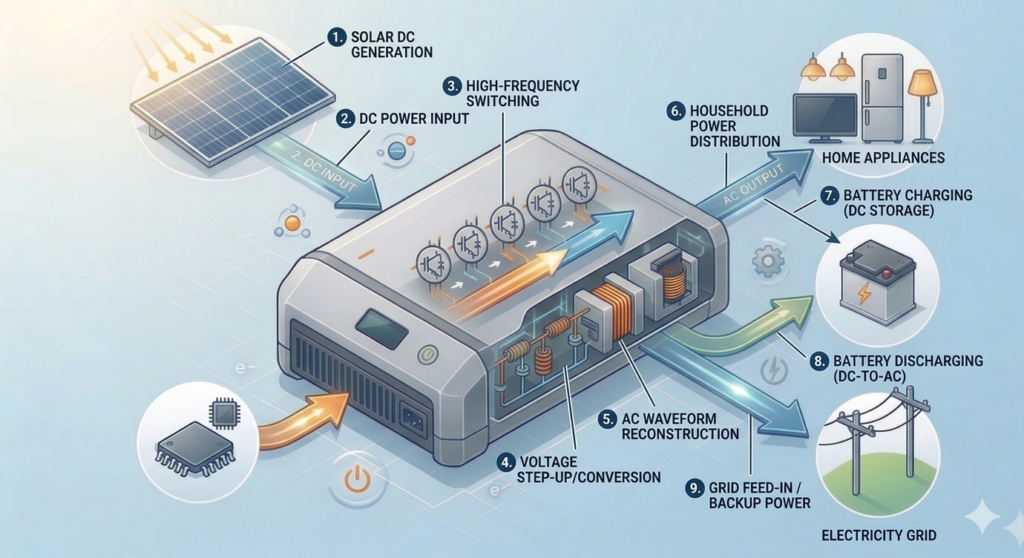
Key Internal Components of a Solar Inverter
A solar inverter is built around several critical internal stages that work together to ensure efficient and stable power conversion. At its core, it includes a Power Conversion Stage that utilizes Switching Devices such as MOSFETs and IGBTs to enable high-speed current switching.
This is complemented by a Filtering Stage, designed to smooth the output signal and shape it into a clean sine wave.
Operation is managed by a Control System based on a Microcontroller Unit (MCU), which controls and coordinates inverter operation and all internal processes.
In addition, the inverter incorporates Protection & Monitoring Circuits to safeguard the system and ensure compliance with grid requirements.
All components are interconnected through a Printed Circuit Board (PCB). Thermal Management systems handle heat dissipation in the power circuits and maintain stable operating conditions.
Below is a more detailed breakdown of the key internal components of a solar inverter:
- Power Conversion Stage: This stage is responsible for converting DC into a raw AC waveform through combined DC-DC and DC-AC conversion (inversion stage).
In some designs, a Transformer may be included, such as in certain models like VEGA inverters, to step voltage up or down and provide electrical isolation. However, most modern inverters are now transformerless. - Filtering Stage: Composed of capacitors and inductors (LC filters), this stage smooths the switching output and converts it into a stable sine wave, while reducing electrical noise, distortion, and interference.
- Control System: It manages inverter operation by executing MPPT algorithms, generating PWM signals, and monitoring voltage and current to maintain optimal performance, especially in systems integrated with lithium batteries for energy storage applications.
- Protection & Monitoring Circuits: These circuits protect the system from overvoltage and overcurrent conditions, while ensuring grid compliance through functions such as anti-islanding in grid-connected systems.
- PCB (Printed Circuit Board): The PCB connects all components and provides structured pathways for signal transmission, ensuring efficient and reliable operation.
- Thermal Management: This includes heat sinks and various cooling mechanisms that dissipate heat generated during power conversion, helping maintain performance stability and extending the inverter’s operational lifespan.
Types of Solar Inverters Used in Modern Systems
Solar inverters used in modern solar energy systems are typically classified into three main types: String Inverters, Micro Inverters, and Hybrid Inverters. This classification is based on system design and how each type manages energy flow within the system.
String Inverters are the most cost-effective and widely used solution. They operate using a centralized architecture, making them relatively simple to install and maintain.
These inverters are best suited for open, unshaded surfaces such as large-scale solar farms or industrial rooftops such as large-scale solar farms or industrial rooftops.
However, despite their reliability, the performance of the entire string is limited by the weakest-performing panel, meaning partial shading or panel mismatch can reduce overall system output.
In contrast, Micro Inverters provide module-level independence by assigning a dedicated inverter to each solar panel. This design ensures consistent energy production even under partial shading conditions and allows for flexible system expansion over time while offering enhanced safety due to lower DC voltage levels.
On the other hand, Hybrid Inverters are designed for advanced energy management. They integrate solar generation, grid interaction, and battery storage into a single system, enabling intelligent control of energy flow.
Hybrid systems also provide immediate backup power for critical loads, depending on battery availability and system transfer time.
To better illustrate the differences, the table below outlines the key characteristics and ideal use cases for each inverter type:
| Aspect of comparison | String | Micro | Hybrid |
|---|---|---|---|
|
Installation |
Centralized (multiple panels connected in a single string). |
One inverter per panel. |
Centralized with battery support. |
|
Key Advantages |
Low cost and easy maintenance. |
High performance under shading and scalability. |
Smart energy management, storage, and backup. |
|
Best Use Case |
Open, unshaded surfaces such as industrial warehouse rooftops. |
Complex or multi-directional roofs (e.g., pitched roofs or roofs with multiple obstructions). |
Homes, farms, and areas with unreliable grid supply. |
|
Limitations |
Performance depends on the weakest panel and limited scalability due to MPPT constraints. |
Higher upfront cost and maintenance requirements physical access to each panel. |
Higher cost and battery maintenance required. |
⚡
Turn Solar Energy Into Reliable Power
Discover how a smart solar inverter can optimize your energy system, delivering stable performance, high efficiency, and uninterrupted power for your home or business.
Contact Us →The Right Inverter = Equipment Protection + Maximum Solar Yield
Even the most advanced solar panels fall short as an investment when not paired with a high-quality solar inverter.
A high-quality inverter equipped with intelligent monitoring and advanced MPPT algorithms is essential for optimizing energy conversion while protecting electrical loads from voltage fluctuations and power instability.
At its core, the solar inverter is the key component that determines how much of the generated solar energy is converted into usable electricity. As smart technologies continue to evolve in the solar industry, selecting a reliable inverter is no longer optional.
It is essential for ensuring energy stability, system performance, and power quality.
In practical terms, working with a trusted solar batteries supplier and inverters manufacturer like Welion Solar provides access to a wide range of high-quality inverters engineered to meet modern energy demands with consistent performance and long-term reliability.
Frequently Asked Questions:
The main distinction between On-Grid and Off-Grid inverters lies in their interaction with the utility grid.
An On-Grid inverter is designed to operate in direct synchronization with the utility grid, exporting excess solar energy into the grid when available, and shutting down automatically during a grid outage for safety reasons. In contrast, an Off-Grid inverter is built for standalone operation, relying entirely on battery capacity to provide continuous and independent power in locations where the utility grid is unavailable or unreliable.
The operational lifespan of a solar inverter typically ranges between 10-15 years, depending on build quality, operating conditions, and maintenance practices.
In most solar power systems, it is the first major component to be replaced, before the solar panels themselves, which generally last longer.
Yes, a solar inverter requires periodic maintenance to ensure optimal performance and system safety.
This includes cleaning ventilation openings to maintain proper cooling and inspecting electrical connections to prevent faults and ensure long-term operational stability.