The difference between a solar system that lasts 3 years and one that lasts 15 years isn’t in the solar panels… it’s in a single technical decision regarding solar batteries. Is your battery just a temporary storage solution or a long-term investment?
The efficiency and longevity of any solar energy system depend heavily on the battery, as it is primarily responsible for storing energy and using it when needed, whether at night or during power outages.
Therefore, choosing a battery is not a simple technical decision. In fact it is a key factor that determines how long your devices will run, the stability of your power supply, and the long-term total cost of the system.
In solar power systems, the question is no longer: What is the battery capacity?
Instead, the most important questions are: How many years will it operate efficiently? and What percentage of its energy will you actually utilize?
Between high-efficiency lithium batteries and lower-cost lead-acid batteries, the equation varies significantly in terms of lifespan, performance, and maintenance. This is why the right choice isn’t always the cheapest… but the smartest.
Choosing the wrong battery could end up costing you twice as much as the solar system itself in the long run.
So, don’t leave the energy stability of your home or business to chance. Contact Welion Solar for a detailed assessment of your needs and to determine the battery type that best suits your budget and load requirements.
Discover how lithium batteries efficiently store energy, boost your system’s performance, and provide uninterrupted power day and night. Find solutions that fit your solar setup perfectly.
Browse Our Solar Battery Options →Table of Contents
ToggleWhat Are Solar Batteries? Types, Uses, and How to Choose the Right One for Your Solar energy System
A solar battery is a rechargeable energy storage unit used in solar power systems. It is designed to store excess electricity generated by solar panels during the day for later use, whether at night or during a power outage.
Storing energy in solar batteries gives the system greater autonomy, reduces reliance on the grid, and ensures that electrical devices continue to operate even in emergencies.
The difference between a solar system with a battery and one without is that the latter wastes excess energy or feeds it back into the grid at low rates, forcing the user to buy electricity again when the sun isn’t shining.
When a battery is used, however, the surplus is stored and utilized later, which helps reduce bills and increase energy independence.
What are solar batteries? They are units for storing energy generated by solar panels and are available in several technologies to meet various needs, most notably:
- Lithium-ion (LiFePO4) batteries: These are highly efficient, can withstand high temperatures, and have a long service life that may exceed 10 years
- Lead-acid batteries: These are characterized by low cost and durability in moderate conditions, but they are less efficient than lithium batteries. Their lifespan is typically between 3 and 7 years for traditional types, and can reach 5–8 years for tubular or gel types when used correctly.
Solar batteries are used in many practical applications, including:
- Home storage: Powering electrical appliances at night or on cloudy days.
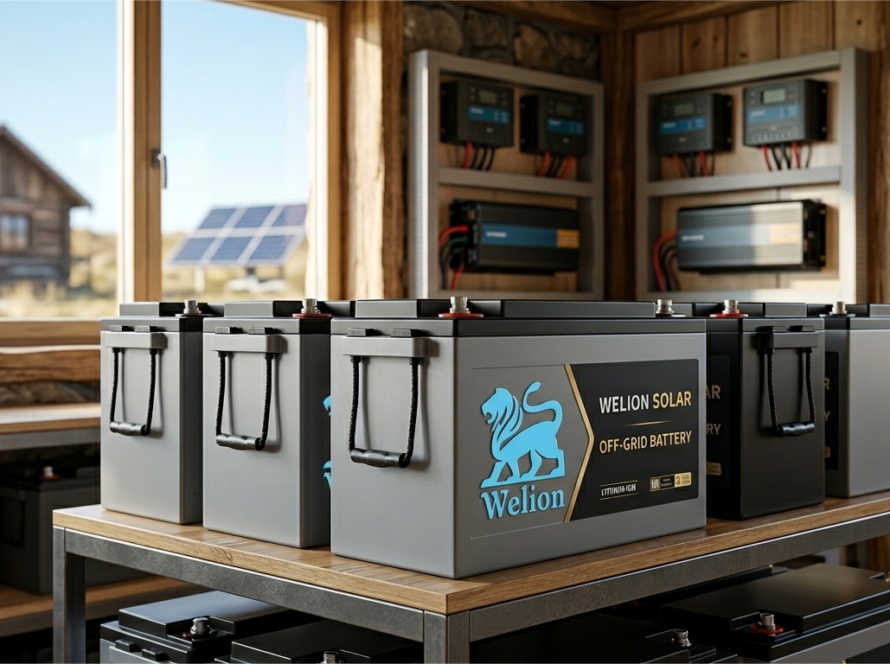
- Off-grid systems: Providing independent power to remote areas not connected to the electrical grid.
- Hybrid systems: To serve as a backup source that reduces reliance on the grid during peak hours or power outages.
- Emergencies: Protecting sensitive devices from sudden power outages.
Modern batteries feature Battery Management Systems (BMS) that regulate charging and discharging and protect the battery from damage, ensuring safe operation and a long service life, while improving the system’s self-discharge rate and energy recovery efficiency.
✋ Before you compare prices… Have you compared the number of cycles, energy efficiency, and the actual lifespan of the batteries? Welion Solar helps you choose the best solar battery , not just the cheapest one. |
How Do Solar Batteries Work? An Explanation of the Energy Cycle and Charge Management
Solar batteries store excess electricity generated by solar panels during the day, making it available when neededwh,ether at night, on cloudy days, or during power outages.
The batteries work in conjunction with the charge controller and inverter to convert energy between direct current (DC) and alternating current (AC), giving the system high autonomy and ensuring that home appliances run smoothly at all times.
Solar Batteries Work Steps and Energy Management:
Daytime Cycle:
- The solar battery cycle begins during the day when the panels generate direct current (DC).
- The energy is first used to power household loads.
- The surplus is stored in the battery as chemical energy.
Nighttime or Cloudy Day Cycle:
- The battery discharges the stored energy.
- The inverter converts this energy back into alternating current (AC) to efficiently power electrical appliances.
Protection in the Event of a Sudden Power Outage:
- The system automatically disconnects from the grid to protect users and maintenance crews.
- The system continues to operate fully on battery power, supplying power to essential devices such as lighting, refrigerators, and the internet.
Smart Charge and Discharge Management:
- This process relies on charge and discharge cycles managed by the Charge Controller and the Battery Management System (BMS).
- This ensures battery longevity and energy efficiency.
Types of Solar Batteries: A Comprehensive Guide to Choosing the Right One
Solar batteries are primarily divided into lithium-ion (Li-ion) and lead-acid batteries, with less common types such as nickel-cadmium and flow batteries for large-scale applications.
Lithium batteries offer high efficiency and a long lifespan, while lead-acid batteries are characterized by low cost and good tolerance for harsh environmental conditions.
Not all batteries are created equal… some last 15 years (such as VEGA 5KWH/200Ah, while others fail after just 3 years
Solar batteries are used to store energy generated by solar panels, allowing electrical loads to continue operating at night or during power outages.
Selecting the appropriate type of solar battery depends on the system size, available budget, and maintenance requirements to ensure optimal long-term performance and efficiency.
1. Lithium Batteries: The Ideal Solution for Efficient and Safe Solar Energy Storage
Lithium batteries (LiFePO₄) are among the most efficient solutions for solar energy systems, featuring high energy density and a long lifespan ranging from 10 to 20 years, in addition to a charge and discharge efficiency of up to 95%.
They also enable energy storage and conversion to electricity when needed with high efficiency and reliable stability.
Key features of lithium batteries in solar energy systems:
- High charging and discharging efficiency: up to 95%, which reduces energy loss and increases system efficiency.
- Long lifespan: Withstands between 4,000 and 6,000 charge cycles, equivalent to more than 10 years of use.
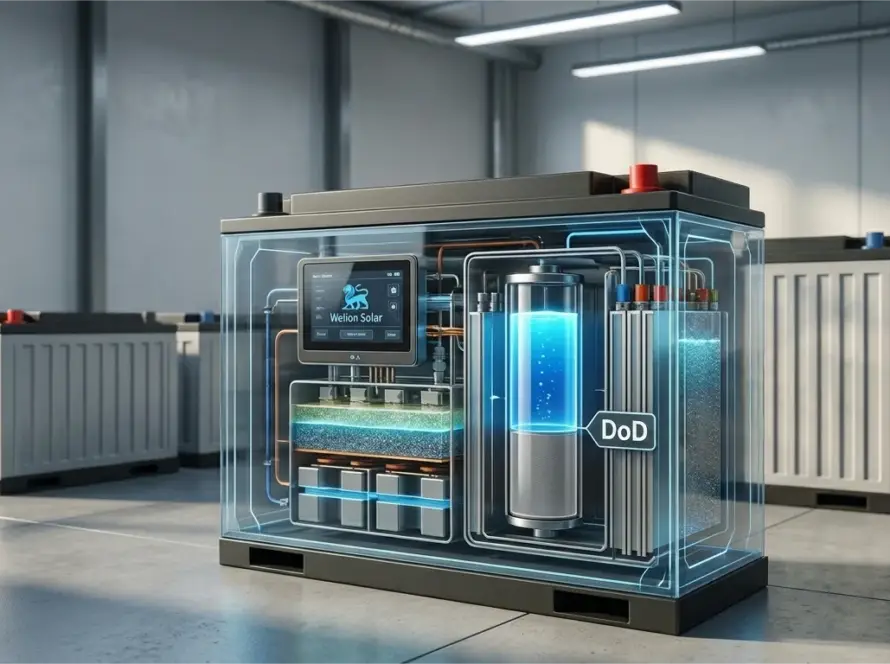
- High Depth of Discharge (DoD): Up to 80–90% of capacity can be used without significantly affecting battery life.
- Smaller Size and Weight: High energy density allows for a smaller installation footprint compared to traditional batteries.
- Fast charging: Requires less charging time compared to lead-acid batteries.
- Low maintenance: Requires no periodic maintenance or fluid top-ups.
- High safety level: Equipped with a Battery Management System (BMS) that protects against overheating and unsafe charging.
2. Gel Batteries: A Safe and Reliable Option for Solar Energy Storage
Gel batteries are an advanced type of sealed lead-acid battery. They use a gel electrolyte instead of a liquid one, making them safer and leak-proof, and they require no regular maintenance.
These batteries perform well in solar energy systems, particularly in deep-cycle applications.
Gel batteries are widely used in small and medium-sized solar power systems, particularly in off-grid systems, where they offer stable performance and good resistance to repeated charge-discharge cycles.
The sealed design of gel batteries also reduces gas emissions, making them suitable for use indoors or in enclosed spaces. However, care must be taken regarding their sensitivity to overcharging, and a suitable charge controller must be used to maintain their lifespan.
Key Features of Gel Batteries in Solar Power Systems:
- Low maintenance: No need to add water or perform regular checks.
- High safety: Leak-proof thanks to the use of gel electrolyte.
- Suitable for deep discharge: Withstands a large number of charge and discharge cycles.
- Long service life: Lasts for several years with proper use.
- Vibration resistance: Ideal for harsh environments and mobile applications.
Do you want a battery that protects your investment and lasts for years? Welion Solar Batteries offers you all types, along with a detailed assessment to help you choose the best option for your project. |
3. Tubular Batteries: The Ideal Choice for Deep Discharge in Solar Power Systems
Tubular batteries are an advanced version of lead-acid batteries, specifically designed for deep discharge. They rely on internal tubular plates that give them a longer lifespan and greater durability compared to traditional batteries.
Tubular batteries are widely used in solar energy systems due to their stable performance and ability to operate in harsh conditions, but they require regular maintenance to ensure they maintain the solar battery efficiency and optimal performance.
Tubular batteries feature a robust internal structure that reduces plate corrosion and improves performance stability during daily use, making them a practical choice for systems that rely on continuous charging and discharging, such as residential and agricultural solar systems.
Key features of tubular batteries in solar energy systems:
- Good lifespan: Typically ranges from 5 to 8 years.
- High charge-discharge cycle endurance: Up to approximately 1,500–3,000 cycles.
- Suitable for deep discharge and regular daily use.
- Strong performance in high temperatures and hot climates.
- Durable tubular structure: reduces active material corrosion and enhances performance stability.
- Cost-effective option: compared to lithium batteries of the same capacity.
Tubular batteries are a suitable battery for off-grid solar systems, farms, water pump operations, and uninterruptible power supply (UPS) systems that require continuous operation and stable loads.
Ready to power your home with solar energy?
Learn how solar batteries work and choose the right solution with Welion Solar.
Start your energy journey today →Battery Capacity: How to Determine the Ideal Energy Storage Requirements
Battery capacity in solar systems is measured in ampere-hours (Ah) or kilowatt-hours (kWh), and it determines the amount of energy available to power devices at night or during a power outage.
Determining the required capacity depends on several factors, most notably: daily energy consumption, the number of days of autonomy or emergency backup (the period during which the battery operates without recharging), depth of discharge (DoD), and the type of battery used.
How is the appropriate battery capacity determined?
- Calculating Daily Consumption (kWh):
Add up the consumption of all electrical devices (power × number of operating hours) to determine the daily energy requirement.
- Determining System Voltage:
Select an appropriate voltage (12V, 24V, 48V) that is compatible with the inverter and charge controller . - Consider the Depth of Discharge (DoD):
Lithium: 80%–90% for maximum energy utilization.
Lead-acid: Approximately 50% to protect the battery and extend its lifespan. - Number of Days of Autonomy:
Determine the number of days you want the system to operate without sunlight, typically one to two days. - Adding a Safety Margin:
It is recommended to increase the capacity by 20% to account for losses and unstable weather conditions, and to ensure reliable system operation.
To calculate the actual battery capacity, the following simple equation can be used:
Actual Capacity (kWh) = Nominal Capacity (kWh) × Depth of Discharge (DoD)
Practical example:
If your lithium-ion battery has a capacity of 10 kWh and the recommended depth of discharge is 80%, the actual energy available for use will be:
10 kWh × 0.8 = 8 kWh
You can safely run your devices on this energy while preserving battery lifespan.
The Lifespan of Solar Batteries: Duration and Technologies That Extend Performance
The lifespan of solar batteries typically ranges from 5 to 15 years and varies significantly depending on the type of battery and how well it is maintained. Lithium batteries have the longest lifespan (up to 10–20 years), while lead-acid batteries typically last 3 to 7 years.
Over time, the battery does not fail suddenly, rather, its capacity gradually decreases until it reaches about 60–70% of its original capacity, which marks the end of its useful life.
Factors Affecting the operational Lifespan of Solar Batteries:
- Number of Charge and Discharge Cycles: An increased number of cycles accelerates internal chemical reactions and reduces storage capacity.
- Depth of Discharge (DoD): Repeated full discharges shorten battery life, while partial discharges help maintain a longer lifespan.
- Ambient temperature: High temperatures accelerate battery degradation and reduce lifespan, while cold temperatures temporarily reduce efficiency without causing permanent damage.
Lithium batteries can withstand higher temperatures, but all batteries benefit from being installed in a cool, well-ventilated location to ensure longer performance. - Maintenance and Battery Management System (BMS): Regular monitoring and cell balancing extend battery life and maintain performance.
⏳ Most people don’t realize that a battery doesn’t fail suddenly… it loses its capacity gradually |
How does a battery’s lifespan actually end?
- Storage capacity gradually decreases with use.
- The battery becomes unable to power loads as efficiently as before.
- Its capacity drops to about 60–70% of its original capacity, indicating the end of its useful life and the need for replacement.
How to Choose the Perfect Battery for Your Solar Power System
Choosing the right battery for your solar power system depends on several key factors, the most important of which are your daily electricity consumption, the battery’s capacity, and voltage compatibility with the solar system.
Lithium batteries are the best choice in terms of lifespan and efficiency, while lead-acid batteries offer a more economical, lower-cost solution. Depth of discharge (DoD) and the number of charge cycles also play a significant role in determining the battery’s performance and long-term lifespan.
Steps for choosing the right battery for your solar system:
- Determine your daily energy consumption:
Calculate your total energy consumption in kilowatt-hours (kWh), this figure determines the battery capacity needed to power your devices efficiently.
- Select the battery capacity (Ah / kWh):
Capacity reflects the amount of energy the battery can store. The higher the capacity, the longer your devices can run without needing to be recharged.
- Voltage Compatibility with the System:
The battery voltage (12V, 24V, 48V) must be compatible with the inverter and charge controller to ensure the system operates efficiently and to prevent malfunctions.
- Battery Type:
Lithium batteries (LiFePO4): Long life, high efficiency, virtually maintenance-free
Lead-acid batteries (Gel / AGM / Tubular): Lower cost but require maintenance and have a shorter lifespan
- Depth of Discharge (DoD):
Choosing a battery that can withstand deep discharge helps you take advantage of greater capacity without affecting its lifespan.
- Cycle Life:
High-quality batteries offer thousands of charge cycles (up to 6,000 cycles), which means a longer lifespan and a better return on investment.
Solar Battery Applications
Solar battery applications include homes and off-grid systems, as well as agricultural projects and the commercial and industrial sectors.
They help reduce reliance on the electrical grid and lower energy costs in the long term, while providing reliable backup power when needed.
Key Applications of Solar Batteries:
- Residential Systems:
Storing energy for use in the evening and powering household appliances, thereby reducing electricity bills and providing backup power during outages. - Off-Grid Systems:
An essential solution for remote or rural areas without access to the power grid, where batteries serve as the primary energy source. - Backup Power Systems:
A silent and safe alternative to traditional generators for powering essential appliances during power outages. - Hybrid Systems:
Integrating batteries with the grid and solar panels to achieve maximum energy management efficiency and reduce grid consumption. - Agricultural Applications:
Powering water pumps, irrigation systems, and lighting on farms, especially in remote areas. - Commercial and Industrial Sector:
Supporting equipment operation, reducing peak-load costs, and ensuring business continuity in companies and factories. - Street Lighting and Public Facilities:
Storing energy during the day to power lighting at night on roads and in parks without the need for an electrical grid. - Charging Electric Vehicles:
Use stored solar energy to charge electric vehicles, reducing costs and emissions.
- Residential Systems:
Enjoy stable, high-efficiency solar power with the experts at Willion Solar
Choosing the right battery for your solar energy system isn’t just a technical decision. it’s a long-term investment that directly impacts the quality and efficiency of the energy in your home or business.
High-efficiency batteries provide greater autonomy, reduce reliance on the grid, and protect your devices during power outages. Conversely, the wrong choice can lead to additional costs and reduced performance in the long run.
With a wide variety of lithium, lead-acid, gel, and tubular battery options available, you can design a system that fits your daily needs, budget, and maintenance requirements, while ensuring longer life and higher efficiency.
Ultimately, investing in the right battery means stable power, lower bills, and optimal use of solar energy, all in a practical and safe way that ensures your devices keep running under any circumstances.
Get stable power for your home or business with Willion Solar!
Let Welion’s experts help you design a comprehensive solar system that offers independence and high efficiency, while ensuring continuous operation of your devices with the highest safety standards.
Frequently Asked Questions:
The difference between kWh and Ah in solar batteries is that Ah (ampere-hours) indicates the amount of charge the battery can store, while kWh (kilowatt-hours) represents the actual energy you can use to power your devices. Simply put: Ah is a technical figure, but kWh is more important because it determines how many hours your devices will actually run. To calculate energy:
kWh = (Ah × voltage) ÷ 1000.
After 5 years of use, lithium batteries typically retain 80–90% of their original capacity, while lead-acid batteries drop to 60–75%. Reduced efficiency means that the amount of energy stored to power devices decreases, which may shorten the operating time of your refrigerator, lighting, or essential appliances.
The difference between 12V, 24V, and 48V batteries is as follows:
- 12V batteries: Suitable for small systems and low-power devices, but require a larger number of batteries to meet greater power needs.
- 24V batteries: Ideal for medium-sized home systems, they provide more power with fewer batteries compared to 12V.48V batteries: The optimal choice for large or commercial systems, they increase system efficiency, reduce power loss in wiring, and allow for greater storage capacity with fewer batteries.