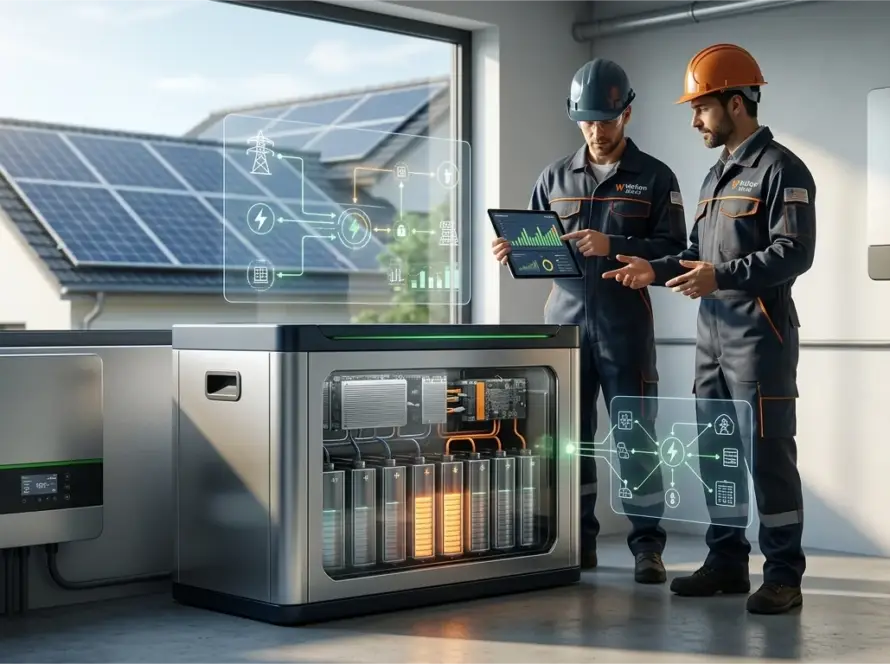
Between lithium, gel, and lead-acid batteries… Today’s question is no longer Should I install a solar system? But rather: Which battery will ensure your system’s durability and efficiency for more than a decade?
Understanding the types of solar batteries, from lithium to gel and lead-acid, has become essential for anyone seeking a sustainable solar system, as they store the electricity generated by solar panels during the day for use at night or during grid outages.
As electricity storage technologies have evolved, several types of solar power batteries have emerged, differing in several key factors that affect performance:
✔ Efficiency of up to approximately 95% for lithium batteries.
✔ Service life and number of charge cycles.
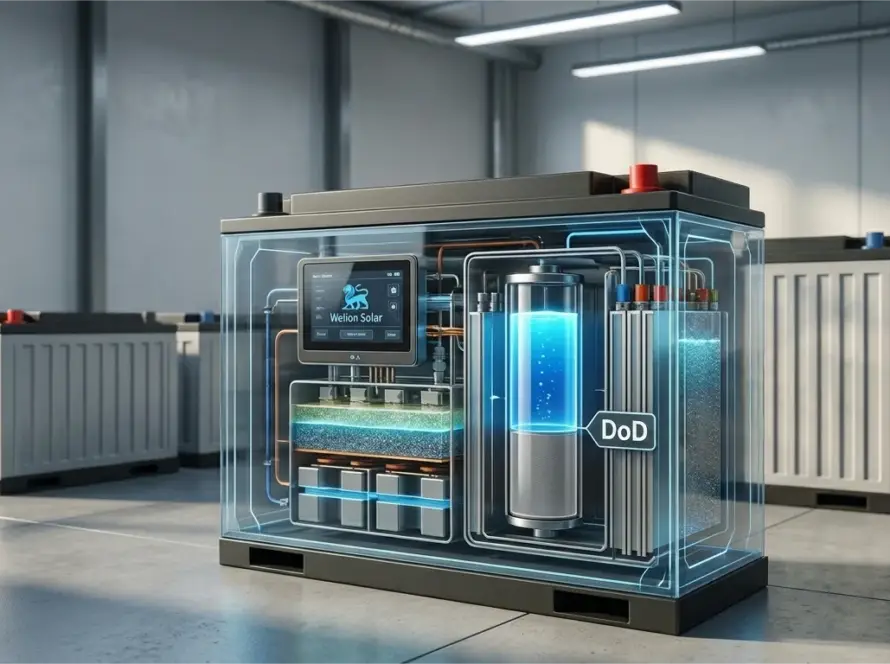
✔ Depth of discharge (DoD) without reducing battery life.
✔ The investment cost of the solar system.
So when you’re unsure which battery to choose, consider the type of solar system (off-grid or hybrid) and your daily consumption to make a smart decision that balances performance and cost.
Build a solar battery system that meets your needs. Don’t leave your choice to chance! We’ll walk you through the different types of solar batteries and their key differences, so you can make a confident and informed technical decision!
Maximize your solar system’s output with the right battery! Choose Welion Solar, the leading supplier of solar energy solutions in the UAE, and benefit from effective solutions that enhance the stability and efficiency of your solar system for years to come. |
Discover how lithium batteries efficiently store energy, boost your system’s performance, and provide uninterrupted power day and night. Find solutions that fit your solar setup perfectly.
Browse Our Solar Battery Options →Table of Contents
ToggleWhy Types of Solar Batteries Matter?
The type of battery used in solar systems varies because battery technologies rely on different chemical compositions and internal designs that affect how electricity is stored and utilized.
The battery’s types differ in the amount of electrical energy that can be drawn from them daily without causing damage, which is the Depth of Discharge of the solar battery.
For example, a 12.8V/100Ah lithium battery can operate at a depth of discharge of approximately 80% and withstand approximately 4,000–6,000 charge and discharge cycles before its capacity decreases.
Batteries also differ in terms of how quickly they charge using electricity from solar panels, and the temperature, which affects battery performance and efficiency within a specific temperature range. For example, it is recommended to charge lithium batteries at temperatures ranging from 0°C to 45°C to maintain stable performance and extend their lifespan, in addition to varying maintenance requirements (such as monitoring the fluid level inside them and periodically adding distilled water to tubular batteries).
Are you looking for sustainability for your solar system?
With the comprehensive guide to solar batteries, you can understand the technical differences that will help you choose the right battery for your solar energy system, striking a balance between storage efficiency, lifespan, and operating costs to ensure stable energy performance over the long term.
Types of Solar Batteries: Your Comprehensive Guide to Choose the Perfect Battery for Your System
There are three main types of solar batteries for storing solar power. The first is lithium batteries (especially LiFePO4 batteries) with 4,000 to 6,000 charge and discharge cycles and energy efficiency typically reaching 90–95%, in addition to the ability to use a high depth of discharge of up to 95%, making them suitable for modern homes that require high efficiency and minimal installation space.
Gel batteries are a type of sealed lead-acid battery in which the electrolyte is a gel, which reduces the risk of leakage and minimizes maintenance requirements.
They offer approximately 500 to 1,200 charge cycles with an efficiency of 80–85%, and are therefore often used in small off-grid applications such as retail stores.
Tubular batteries are known for their high tolerance for repeated charge-discharge cycles due to the design of the tubular plates inside the battery, which allows them to achieve 1,200–2,000 cycles and a service life of 5–8 years.
They are typically used in agricultural solar systems that require daily operation and regular discharge cycles.
Solar power batteries fall into three main types:
1- Lithium batteries.
2- Gel batteries.
3- Tubular batteries.
Understanding these types and their technical characteristics helps discover what are solar batteries and how to determine which solar battery are suitable for renewable energy systems, ensuring a balance between storage efficiency, lifespan, and operating costs.
1. Lithium Batteries: A Highly Efficient Technology for Storing Solar Energy
Lithium batteries are rechargeable electrochemical energy storage devices that rely on the movement of lithium ions (Li⁺) between the negative electrode (anode) and the positive electrode (cathode) through an ion-conducting electrolyte.
During discharge, these ions move from the anode to the cathode, while electrons flow through the external circuit to generate a direct current (DC).
During charging, this process is reversed to store energy back into the cells.
LiFePO4 (Lithium Iron Phosphate) batteries are the most widely used technology in modern solar power systems.
They feature a stable chemical structure based on iron phosphate, which gives them high thermal stability and fire resistance compared to other lithium technologies such as NMC (Nickel Manganese Cobalt).
The voltage per cell is approximately 3.2 volts. Multiple cells are combined to create systems with voltages of 12V, 24V, or 48V, allowing them to be used in various sizes of residential or commercial solar power systems.
Advantages of Lithium Batteries: Long Lifespan and Exceptional Performance for Your Solar System
- Lithium batteries can withstand a large number of charge cycles, up to 4,000 to 6,000 cycles, at a depth of discharge of 60% to 80% of their original capacity.
- Lithium batteries can be discharged to 80%–90% of their capacity daily without significantly affecting their operational lifespan, a ratio known as the depth of discharge.
- The charge and discharge efficiency of lithium batteries typically ranges between 90% and 95%, meaning that most of the stored electrical energy can be recovered during use.
- Lithium batteries can store more electricity in a smaller size and weight, so they require less installation space and fewer batteries to achieve the same storage capacity.
A simple example: To store 5 kWh in a residential solar power system, you need a LiFePO4 battery weighing approximately 40–50 kilograms.
- Maintenance is virtually nonexistent, as lithium batteries do not require monitoring of fluid levels, they are fully sealed and operate automatically.
- Most lithium batteries charge within a temperature range of 0°C to 45°C without significant loss of capacity.
- Fast charging time of approximately 2–4 hours, depending on the use of a suitable battery charger or charge controller (such as the MPK Controllers 40Ah), as well as the C-rate, charger capacity, and BMS limits
- The presence of a Battery Management System (BMS) prevents overcharging and protects the lithium battery from excessive deep discharge and overheating, while also extending the battery’s lifespan by approximately two times compared to an unprotected battery.
Disadvantages of lithium batteries: Cost challenges, safety And operational considerations
- The initial cost of lithium batteries is high.
- A lithium battery cannot function without a Battery Management System (BMS), which adds complexity and initial cost to the system and requires maintenance or monitoring in the event of a malfunction; furthermore, any failure in the BMS can lead to significant problems for the battery (such as overcharging).
- Lithium battery performance is affected by temperature; it must not drop below 0°C or rise above 45°C during charging, as this can damage the battery.
- If a lithium battery is subjected to strong impacts or punctures, it can cause a fire, so it requires proper installation and protection.
Common Uses of Lithium Batteries: Smart Solutions for Modern Homes and Businesses
- Modern homes use them to store excess energy generated by solar panels and use it at night or during power outages.
- Hybrid Solar Systems, which work with hybrid inverter to store energy and efficiently manage grid and solar power consumption.
- Small commercial projects like stores, offices, and restaurants need a stable backup power system and want to reduce their reliance on the electrical grid.
- A backup power system that is used as an electrical energy storage solution in homes or businesses to power essential devices (such as computers) during power outages.
Practical Example
In a 5-kilowatt residential solar power system, a 10kWh LiFePO4 battery can be installed to store energy generated during the day and use it to power household loads at night, such as lighting and essential electrical appliances, with high efficiency and low energy loss.
Determine your solar battery capacity accurately, to get the right types of solar batteries and most out of every kilowatt-hour in order to power your devices with high efficiency and minimize losses.
2. Gel Batteries: The durable, low-maintenance choice for harsh conditions
Gel Batteries are a type of sealed lead-acid (SLA) battery – SLA), but instead of having a liquid electrolyte inside the battery, the acid is mixed with silica to form a gel. This design prevents acid leakage and reduces electrolyte stratification, while also improving the stability of the electrochemical reaction during charge and discharge cycles in the battery.
Benefits of Gel Batteries: Reliable Power and High Resistance to Temperature Fluctuations
- Gel batteries require minimal maintenance due to their gel electrolyte, which makes them completely sealed.
For example, they do not require the addition of distilled water. - Gel batteries have a low self-discharge rate, typically ranging from 1–3% per month, allowing for long-term energy storage without significant capacity loss.
- Gel batteries can operate effectively in a temperature range from -20°C to +50°C without rapid degradation, as the battery’s capacity remains relatively stable without rapid loss of capacity.
- When used in a deep-cycle charging and discharging system (approximately 50% depth of discharge), a gel battery typically withstands 700–1,500 charge-discharge cycles before its capacity drops below 80% of its original capacity.
- Gel batteries are safer to operate and do not produce acidic fumes due to their gel composition, which reduces the risk of fire at the installation site.
- Resistance to vibration and mechanical shocks in industrial or agricultural environments, thanks to the gel’s internal structure, reduces electrolyte movement within the battery cell.
- Gel batteries are a mid-range option, as their price is significantly lower than that of lithium batteries.
Disadvantages of Gel Batteries: Important Notes on Charging and Depth of Discharge
- They cannot withstand repeated deep discharges like lithium batteries because the internal gel may be damaged and become irreparable, furthermore, discharging beyond 50% rapidly reduces their service life.
- Charging time is relatively longer (6–8 hours for a full charge) due to the higher internal resistance caused by the gel electrolyte.
- They are sensitive to improper charging; using an unsuitable charger or overcharging can cause permanent damage to the internal gel, significantly reducing the battery’s lifespan.
- The lifespan of a gel battery is shorter in solar systems that operate with intensive daily cycles.
Where are gel batteries used? Ideal solutions for remote areas and off-grid systems
- Medium-capacity solar systems in small shops or cafes, as well as medium-sized homes.
- Off-grid solar systems for remote areas to store excess electricity from solar panels during the day and use it at night in homes not connected to the grid.
- Agricultural applications, such as operating pumps or providing lighting on farms without access to the public power grid, as they provide a stable power supply without the need for regular maintenance.
- Backup power systems are used in UPS (uninterruptible power supply) systems or backup lighting to provide a stable power supply during power outages.
Practical example: A residential solar power system using gel batteries
In a 5-kilowatt residential solar system, a 12V–200Ah gel battery with a capacity of 200 ampere-hours can be installed to store the energy generated during the day.
Improve the efficiency of your solar batteries and enjoy stable, reliable energy storage all day long with low-maintenance gel batteries.
3. Tubular batteries: Power and durability for heavy loads and daily use
Tubular batteries are an advanced type of deep-cycle lead-acid battery that differs from traditional lead-acid batteries in the design of their internal plates.
They feature tubular positive plates containing the active material (lead dioxide, PbO₂) surrounded by porous polyester tubes.
The design of tubular batteries is well-suited for solar power systems that require frequent charge-discharge cycles, as it reduces active material shedding and plate corrosion, and allows the battery to withstand a greater number of charge-discharge cycles before its capacity decreases, thereby extending the battery’s lifespan.
How do tubular batteries work?
Tubular batteries rely on an electrochemical reaction between lead dioxide (PbO₂) at the positive electrode and lead (Pb) at the negative electrode within an electrolyte composed of sulfuric acid (H₂SO₄) to generate an electric potential.
When the battery is charged by solar panels, the electric current converts the lead sulfate (PbSO₄) formed on the plates into (Pb) and (PbO₂), allowing energy to be stored within the battery as chemical energy that can later be used to power electrical devices.
When electrical devices are turned on, chemical reactions take place, converting stored chemical energy into electrical energy that powers household or agricultural loads.
Features of tubular batteries: Exceptional ability to withstand deep charge cycles
- They typically withstand between 1,500 and 3,000 charge and discharge cycles at a depth of discharge of approximately 50%, which is higher than many traditional lead-acid batteries.
- Operational lifespan often reaches 5–8 years when used in residential solar power systems.
- Good performance at high temperatures up to approximately 40°C without a rapid decline in performance.
- The tubular plate design reduces active material corrosion and makes the battery suitable for frequent daily discharges.
- Tubular batteries are suitable for systems operating on daily cycles (charging during the day and discharging at night). Capable of withstanding deep discharge up to 80% of the battery’s capacity without rapid degradation.
- Resistance to corrosion and active material shedding thanks to the tubular plate design that keeps the active material inside, and consistent performance under continuous electrical loads (such as water pumps).
Challenges of Tubular Batteries: What You Need to Know About Maintenance and Size Before Purchasing
- The energy efficiency of tubular batteries ranges from approximately 75% to 85%. This means a loss of 15–25% of stored energy as heat during charging and discharging cycles, which is relatively twice as high as that of lithium batteries.
- Most tubular batteries require regular maintenance. For example, flooded lead-acid batteries need distilled water added every few months to balance the electrolyte level and maintain the performance of the internal plates.
Additionally, most tubular batteries are not fully sealed. - Tubular batteries are heavier and larger than lithium batteries because they rely on lead and liquid electrolyte, which requires more installation space in solar power systems.
A simple example: To store 10 kWh, a LiFePO4 battery requires approximately 90 kg and 0.2 m³ of space, while a tubular lead-acid battery weighs about 275 kg and requires 0.55 m³ of space.
- Tubular lead-acid batteries typically take 8 to 10 hours to reach a full charge in solar systems, depending on the charger type and charging current. This is a long time compared to lithium batteries.
- Frequent use of the battery at a depth of discharge higher than 60%–70% can reduce the number of charge cycles and shorten the operational life.
Top Applications for Tubular Batteries: From Agricultural Projects to Home Systems
- Off-grid solar power systems for homes that require reliable daily electricity storage.
- Agricultural projects such as operating irrigation pumps and lighting systems on farms.
- Backup power systems for homes or small facilities that experience frequent power outages.
- Heavy-duty vehicles and industrial equipment (such as electric cranes and small electric trucks).
- Rural or remote locations that rely on solar power as their primary source of electricity.
- Devices that require deep-cycle charging (such as UPS systems or emergency generators).
Practical example: Tubular solar batteries in an agricultural project
On a small farm or in an irrigation project using a solar-powered water pump, Welion 12V 200Ah tubular batteries can be installed to store energy generated by solar panels during the day. These batteries are used to power water pumps for irrigation, operating for extended periods at night or when the sun is not shining.
Discover how batteries in solar energy systems work to store energy during the day and power loads at night efficiently, and take advantage of the tubular design to withstand stable daily charge and discharge cycles.
Ready to power your home with solar energy?
Learn how solar batteries work and choose the right solution with Welion Solar.
Start your energy journey today →A comprehensive comparison of solar battery types: Lithium vs. Gel vs. Tubular
The main difference between types of solar batteries lies in their operational lifespan. Lithium-ion batteries have a longer lifespan of up to 12 years compared to gel batteries and lead-acid/flooded batteries. These batteries also differ in terms of efficiency, with lithium and gel batteries being the most efficient at up to 95%, compared to traditional flooded batteries.
In terms of cost and maintenance, tubular batteries are initially cheaper but require regular maintenance compared to low-maintenance gel and lithium-ion batteries. As for the permissible depth of discharge (DoD), lithium batteries allow for 80–100% of their capacity to be used, which is an ideal value compared to gel and lead-acid batteries.
Comparison Between types of solar batteries (Lithium, Gel, Tubular Batteries)
Standard | Lithium | Gel | Tubular |
Operational lifespan | 10-15 years | 5-8 years | 3-5 years |
Efficiency | Efficiency of 90%–95% | Efficiency ranges from 80% to 90% | Efficiency ranges from 75% to 85% |
Initial Cost | the most expensive battery | Moderate cost, making them an economical choice for small solar power systems. | unexpensive initially, but requires frequent replacement. |
Maintenance requirements | Lithium batteries are virtually maintenance-free due to battery management systems (BMS) that control charging and discharging and protect the cells from damage. | Low maintenance because gel batteries are sealed and do not require water top-ups or frequent checks. | regular maintenance, such as adding distilled water. |
Allowed Depth of Discharge | 80–100% of the battery’s capacity can be used | 60–80% of the battery’s capacity can be used. | It is best not to exceed a depth of discharge of 50% of the battery’s capacity. |
Which battery is best suited for your solar system? Criteria for making the right decision
Selecting the right battery for a solar energy system depends on daily electricity consumption to determine the required storage capacity and number of charge cycles, the type of systemmwhether residential or off-grid, to identify the most suitable battery for various environmental conditions such as heat and dust, and the available budget, which determines the feasibility of investing in batteries.
The following are the most important factors for choosing the right battery for a solar energy system:
- Daily electricity consumption: For systems requiring large-scale energy storage, lithium batteries with a depth of discharge of 80%–90% and a high number of charge cycles are preferred, while smaller systems can function well with gel or lead-acid batteries.
- Type of solar power system: Residential systems require fast-charging, high-efficiency batteries, so lithium is often the preferred choice. For agricultural or off-grid systems, gel or tubular lead-acid batteries can withstand harsh conditions such as heat and dust.
- Budget Considerations: Lead-acid batteries are less expensive but require maintenance and have a shorter lifespan, while lithium batteries are initially more expensive but are more durable and cost-effective in the long run.
Expert Tips for Choosing the Best Solar Battery: How to Secure Your Investment?
With the wide variety of solar battery types and their differing characteristics in terms of efficiency, lifespan, and depth of discharge, understanding these types is an essential step in ensuring a stable solar energy system that provides you with electricity for many years without recurring problems or unexpected costs.
Whether you’re considering high-efficiency lithium batteries, low-maintenance gel batteries, or tubular batteries suitable for large systems, making the right choice always starts with understanding the needs of your solar power system by:
✔ Accurately calculating your daily electricity consumption.
✔ Don’t choose a battery based on price alone, check the number of charge cycles and the lifespan.
✔ Selecting the right battery for the operating environment, such as a hot climate.
Invest wisely in a solar power system with Welion Solar, choose the type that balances your budget with operational efficiency to ensure your energy supply lasts for years to come!
Frequently Asked Questions:
The difference between lithium batteries and gel batteries is that lithium batteries offer high energy density with lighter weight and a long cycle life (typically 4,000–6,000 cycles at 80% DoD), and they handle deep discharge efficiently without significant loss of capacity.
Gel batteries, on the other hand, rely on a gel electrolyte to hold the acid in place, making them leak-proof and suitable for harsh environmental conditions such as heat and dust; however, they have a lower number of charge cycles (approximately 700–1,500 cycles at 50% DoD) with their efficiency that decreases during deep discharge.
The difference between lithium batteries and tubular batteries is that lithium batteries feature fast charging, long life, and high efficiency (90–95%), with virtually no maintenance thanks to the battery management system (BMS).
Tubular lead-acid batteries, on the other hand, are designed to withstand repeated deep discharges down to 80% of their capacity and typically last 5–8 years, but they are heavier and bulkier, and require periodic maintenance such as adding distilled water, similar to flooded batteries.
The difference between gel batteries and tubular batteries is that gel batteries are low-maintenance, leak-proof, and shock-resistant, and can withstand a wide range of temperatures. However, they have limited capacity during deep discharge and last shorter than tubular batteries.
Tubular batteries, on the other hand, offer greater storage capacity and can withstand repeated full discharge cycles without significant loss of efficiency, making them suitable for long-term use in large residential solar power systems and agricultural projects.