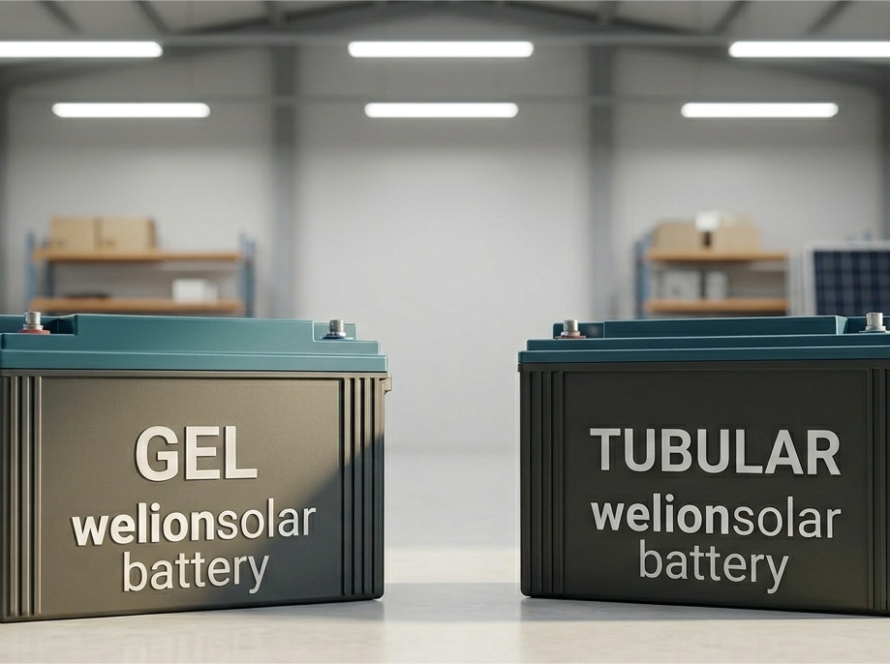
In the world of solar energy, the numbers you don’t understand are the ones that will cost you the most!
Many people think that buying a 200Ah battery means getting full power, but the harsh reality lies behind the solar battery capacity, which is directly affected by the temperature and depth of discharge of solar batteries.
You should know that choosing the right solar battery capacity depends on:
✔️Daily energy consumption ✔️Number of operating hours required ✔️Depth of Discharge
So, don’t let battery capacity confuse you. Join us in this article from Welion Solar for solar energy solutions to discover everything related to solar battery capacity, while highlighting the most common mistakes you might encounter when choosing a battery that suits your solar system.
Table of Contents
ToggleWhat Is Solar Battery Capacity?
The capacity of solar batteries refers to the amount of energy that can be stored within the battery for later use in generating electricity (during periods without sunlight, for example), and is measured in kilowatt-hours (kWh) or ampere-hours (Ah) (where 1 kWh = 1,000 Wh).
Consequently, battery capacity determines the number and duration of electrical device operations, making it one of the most important factors determining the performance of a solar system.
Solar battery capacity is calculated in watt-hours (Wh) if the capacity in ampere-hours (Ah) is known, using the following equation:
Battery capacity (Wh) = Battery capacity (Ah) × Voltage (V)
Do you know the battery capacity in ampere-hours (Ah) and want to know how many kilowatt-hours (kWh) it provides? The following example will explain this:
Example: A battery with a capacity of 1,200 Ah and a voltage of 22 V has a capacity of 26.4 (kWh)
1200(Ah)×22(V)=26400(Wh)
26400(Wh)÷1000=26.4(KWh)
Therefore, the battery capacity is 26.4 (kWh).
Learn how to choose the right lithium battery to maximize efficiency, enhance performance, and ensure reliable power for your solar energy system day and night.
Find the Optimal Solar Battery →Ah vs kWh in Solar Batteries: What’s the Real Difference
Units of measurement for Battery Capacity include both (kWh) as a measure of total energy and (Ah) as a measure of current charge, your choice of the appropriate unit depends on the system’s voltage.
- Kilowatt-hour (kWh): Represents the amount of electrical energy consumed over one hour at a rate of one kilowatt. It is the most accurate measure for assessing total stored energy.
For example: A 150-amp-hour battery at 12 volts produces 1.8 kilowatt-hours ((150 × 12) ÷ 1000), capable of powering a TV, a fan, and 10 light bulbs for 7 hours, a requirement met by the 12V – 150Ah Gel Battery.
- Ampere-hours (Ah): Used as a key measure of the electrical charge transferred by a constant current of one ampere over the course of one hour.
For example: A battery with a capacity of 150 amp-hours can deliver 150 amps for one hour. It can also deliver 75 amps for two hours at a constant voltage.
The difference between amp-hours and kilowatt-hours lies in how these units represent battery capacity (kilowatts represent an overall energy rating, while amperes represent the battery’s capacity to withstand a load), where one kilowatt-hour (kWh) expresses the storage and output capacity of batteries during prolonged operation, and one ampere-hour (Ah) describes the battery’s output capacity and performance when subjected to an instantaneous load.
KWh can be used as a standard for comparing the efficiency of different solar systems (12V vs. 48V), while Ah should be used when comparing batteries operating at the same voltage (such as when comparing different types of 12V batteries).
How to Calculate Solar Battery Size
Calculating the capacity of solar batteries involves two basic steps: determining the energy consumption of your electrical appliances in kilowatt-hours (e.g., a refrigerator consumes approximately 2 kWh per day) and the required operating time (in hours).
Here is a simplified explanation of how to calculate the solar battery capacity based on your home’s energy consumption and the operating time of electrical appliances:
The consumption of any electrical appliance can be calculated by determining its power rating (usually listed on the appliance’s label) and the number of operating hours.
We use the following formula to calculate power consumption:
Power consumption (kWh) = Device power (W) × Number of operating hours
The voltage of the battery to be used and the maximum allowable discharge rate must be determined in order to calculate the battery’s actual capacity. We then apply the following formula:
Battery capacity (Ah) = Daily power consumption (Wh) ÷ (Discharge rate × Voltage × Efficiency)
In the following example, we will demonstrate how to calculate battery capacity by applying the formula in practice:
To determine the appropriate battery capacity for powering a 120-watt TV for 5 hours, we calculate the TV’s power consumption:
100(W)×5(H)= 500(Wh)
Battery capacity: Let’s assume the battery voltage is 12 volts, the depth of discharge is 50%, and the efficiency is 85%
500÷(12×0.5×0.85)=98.03(Ah)
Therefore, you need a battery with a capacity of 100 Ah if it has a voltage of 12 volts and a discharge rate of 50%. This is exactly what a Gel Battery 12V- 100Ah provides.
Take the Next Step Toward Smarter Energy
Let Welion Solar help you choose the ideal solar battery and design a solution that fits your home perfectly.
Get in Touch →Recommended Battery Capacity for Homes
The appropriate solar battery capacity for residential use ranges from 7 to 18 kWh, with the determination of capacity depending on daily energy consumption, the depth of discharge, and the voltage.
It is also important to ensure that the capacity of residential batteries is sufficient to meet our energy needs in the event of a lack of sunlight due to weather conditions.
Here is an example of how to calculate the battery capacity for a home with average electricity consumption:
Let’s assume your daily energy consumption is 7,500 Wh, the battery voltage is 48 V, the efficiency is 95%, and the depth of discharge is 80%.
To convert battery capacity to watt-hours, we use the following equation:
Battery capacity (Wh) = Battery capacity (Ah) × Voltage (V)
Battery capacity (Wh) = 203.45 × 48
By dividing the result by 1000 to convert to kilowatt-hours, the battery capacity will be approximately 10 kWh.
💡Did you know that a 10 kWh lithium battery is ideal for you if your daily electricity consumption ranges from 6,500 kWh to 7,500 kWh?
Hurry and order it now from the diverse range of Welion batteries.
Factors That Affect Solar Battery Capacity
The capacity of solar batteries is affected by the ambient temperature (the ideal temperature is 25°C), the depth of discharge (DoD), which determines the percentage of energy used, and the number of charge and discharge cycles, which determine the battery’s lifespan.
The effect of temperature varies depending on the solar battery types. For example, lithium batteries are ideal for use in hot climates (25–45°C), while gel and lead-acid batteries are better suited for cooler environments (20–30°C).
Depth of discharge represents the percentage of the battery’s capacity that has been used, and an increase in the number of charge and discharge cycles leads to a reduction in battery life.
Extend your battery’s life and improve its performance by considering the following factors:
- Temperature.
- Depth of discharge (DOD).
- Number of charge and discharge cycles.
1. How Temperature Affects Solar Battery Capacity?
The effect of temperature on battery capacity varies depending on the type of battery (lithium, gel, or lead-acid). When the temperature rises above 25°C, the rate of chemical reactions inside the battery increases, which can cause the battery’s compounds to degrade, leading to a decrease in capacity. Conversely, when the temperature drops below freezing, the internal resistance to chemical reactions inside the battery increases, hindering performance and reducing battery capacity.
Lithium batteries are suitable for use in both high and very low temperatures, while gel batteries are suitable for high temperatures, and lead-acid batteries are suitable for use in moderate-temperature environments.
Here are more details on the type of battery best suited for use based on temperature:
- Lithium Batteries:
Lithium batteries are suitable for use at very high temperatures (up to 45°C, or 140°F), as high temperatures accelerate the chemical reactions within the battery’s internal system.
At very low temperatures down to freezing (-40°C, equivalent to -40°F), the battery’s resistance to charging increases.
- Gel Batteries:
Suitable for use at high temperatures (up to 40°C, or 104°F) because the gel electrolyte (positive or negative free ions in a solvent such as water) acts as a protective barrier that prevents the evaporation of fluids inside the battery.
At low temperatures (below freezing), its capacity decreases significantly, and the gel electrolyte may freeze (its performance is considered better than that of lead-acid batteries at both high and low temperatures). - Tubular Batteries:
Suitable for use in environments with moderate temperatures (around 25°C or 77°F); as temperatures rise above this level, capacity decreases, the electrolyte may evaporate, and the battery may be damaged.
At very low temperatures, the battery may lose a significant portion of its capacity due to the possibility of the acid inside freezing.
2. Depth of Discharge (DoD): How It Determines Your Battery’s Usable Capacity
Depth of discharge is the percentage of a battery’s capacity that can be discharged without negatively affecting its lifespan (for example, discharging 80 amp-hours from a 100-amp-hour battery means a DOD of 80%).
With each charge and discharge cycle of a solar battery, the depth of discharge exceeds the permissible limit due to chemical degradation within the battery and an imbalance in its internal chemistry, which causes the battery to degrade and its capacity to decrease significantly.
The following example illustrates the actual usable capacity based on the specified depth of discharge (DOD) for a solar battery:
A battery with a capacity of 10 kWh and a specified DOD of 90% (meaning you can safely use 90% of the battery’s capacity).
Actual usable capacity = 10 kWh × 90%
Actual capacity = 9 kWh
The remaining 10% of the battery’s capacity is reserved to protect the battery’s internal chemical composition.
3. Battery Cycle Life: How Charge and Discharge Cycles Impact Lifespan
An increase in the number of charge and discharge cycles leads to a gradual and continuous decline in the capacity of solar batteries, as each cycle causes chemical and structural stress on the internal components, reducing the battery’s ability to retain energy over time.
Since batteries are designed to last for a certain number of cycles before their capacity drops to about 80% of their original value, the number of charge and discharge cycles varies depending on the type of solar battery.
The following table provides approximate figures for the number of charge and discharge cycles for each battery type:
Battery Type | Number of charge and discharge cycles |
Lithium | 4000-7000 |
Gel | 600-1200 |
Tubular | 500-1000 |
Types of Solar Batteries: Key Differences and How to Choose the Right One
The most common types of solar batteries include lithium batteries, gel batteries, and tubular lead-acid batteries.
These batteries differ in their chemical composition (lithium ions for lithium batteries, and lead combined with liquid sulfuric acid for lead-acid batteries, and in gel form for gel batteries), cost (lithium batteries are the most expensive), and lifespan.
Don’t forget to consider their maintenance requirements and the size of your solar energy system.
Here is a table showing the differences between types of solar batteries:
Comparison | Lithium Battery | Gel Battery | Tubular Battery |
Chemical composition | Lithium ions | Lead and sulfuric acid (gel) | Lead and sulfuric acid (liquid) |
Cost | Expensive | Moderate | Cheape |
Operational Lifespan | 10-15 years | 3-5 years | 1-3 years |
Depth of Discharge | 80-90% | 50-60% | Maximum 50% |
Maintenance | Zero maintenance | Low maintenance | Periodic maintenance |
Type of solar system it is suitable for | Large-scale solar systems, such as desalination plants | For large to medium-sized solar systems, such as factories | Used in small solar systems, such as cooling systems |
The following example illustrates the appropriate battery type based on the size of the solar system:
Economy-class residential system: We choose lead-acid batteries for use solely for lighting and charging when there is no sunlight or electrical power.
Medium-consumption residential system: We choose gel batteries for use when there is no sunlight or electricity for lighting, charging, and operating some electrical appliances while a direct power supply from solar panels is available, i.e., when sunlight is available.
High-Consumption Solar System: We select lithium batteries for use day and night to provide lighting, charging, and power to high-capacity electrical appliances (such as refrigerators and washing machines) for extended periods.
Solar Battery Capacity: Beyond the Numbers... Choosing Smartly
Solar battery capacity isn’t just a number on a technical specification sheet. It’s a balance between your daily needs and the lifespan of your solar energy system.
And always remember that choosing the wrong capacity today means double the maintenance and replacement costs tomorrow, so don’t leave your system to guesswork.
Instead, accurately calculate your daily energy consumption, consider your environmental conditions, and choose the technology that matches this consumption, taking into account the number of charge-discharge cycles and the battery’s discharge rate.
Get started today with the advanced Welion battery range and ensure you have endless power with a capacity that never lets you down.
Discover everything about what are solar batteries through the comprehensive guide to sollar batteries.
Frequently Asked Questions:
Yes, a solar system can be equipped with a second battery—preferably of the same type—which is connected to the existing battery, provided that the existing battery has not been in use for more than two years. This is because using an old, worn-out battery alongside a new one can limit the performance of the new units.
Battery’s operational lifespan varies depending on the type: lithium batteries last approximately 10 to 15 years, gel batteries last 3 to 7 years, and lead-acid batteries last 5 to 7 years.
It’s important to convert amperes to kilowatt-hours to understand how electrical devices consume energy over time, as well as to choose a solar battery capacity that suits your needs.